
 Posted by
 Your school lunch tray does… but should it?
By Lindsey Clinton, Co-Editor-In-Chief
You stand in line waiting to get lunch in a room packed full of hungry students. Grab your tray, take a milk, and then get lunch. Once you get through the line and pay, your milk is immediately added to the mountain of cartoons filling the closest garbage. But these everyday happenings add up in the long run, as it is estimated by WorldWildlife that waste in schools from milk alone equates to 45 million gallons per year. Maybe it’s time we took a closer look at the school lunches we eat on a daily basis
A federally assisted meal program, the National School Lunch Program, operates in over 100,000 public and non-profit private schools and residential child care institutions, including the New Paltz Central School District. Within these meal programs, participating schools receive between $1.30 and $3.81 per lunch to produce a school lunch, intending to cover all costs of food, labor, equipment, electricity, and other costs. With this limited amount of money spent on each meal and its preparation, what gets put on a student’s lunch tray tends to be limited and cookie cutter.
The first thing a New Paltz student adds to their tray is a classic: Milk. But why is this a mandatory part of our meals? Put into law in 1946, President Harry S. Truman signed the National School Lunch Act, authorizing the National School Lunch Program (NSLP), stating that one of the five dietary staples required would be half a pint of milk. This plays an integral part in federal school meals because of its nutrient package, being the number one food source of the 13 essential nutrients in American children’s and adolescent diets. More recently, a study conducted in 2017 by the USDA (US Department of Agriculture) concluded that 77% of daily milk consumption for low-income children ages 5-18 came from the national school meal programs. This in itself underscores the true importance of milk in school meals, helping children meet their nutritional needs for development and growth, but the question now stands if it should continue to be mandatory. From dietary restrictions to just basic preferences, so many students do not actually drink the milk they must get. Instead of enforcing milk to be on every lunch tray, we should be focusing on making sure there are other available options like water. But the limited options for students do not end with the conversation over milk as it pertains to the meal itself.

Lily Dwan, student at Northwestern Regional School District No.7 in Connecticut, comments “As far as the nutritional value goes, I think that they do meet all the FDA requirements, but they are so low quality and small portions.”
Maybe part of the focus for schools should as well be placed on the importance of portion sizes. These same concerns Dwan mentions were referred to by New Paltz High School Junior, Trey Nitza as he concurred, sharing “I think they’re a little too small, possibly to accommodate for the fact that they don’t make enough to give more to every student. I often go back for seconds or bring something from home so I will have enough to eat.”
Dwan further stresses this point by explaining that the calories “barely meet the daily intake for our age group, and the problem with this is that not many of us eat breakfast, and some students may not be able to afford a nutritional dinner.”
The importance of school provided meals are astronomical. Students may solely rely on the breakfast or lunches they can receive as a way to fuel their bodies. Journalist Leah Rodriguez finds that during the pandemic, only 15% of children in low-income families in the United States that qualify for free or reduced lunches were able to receive them.
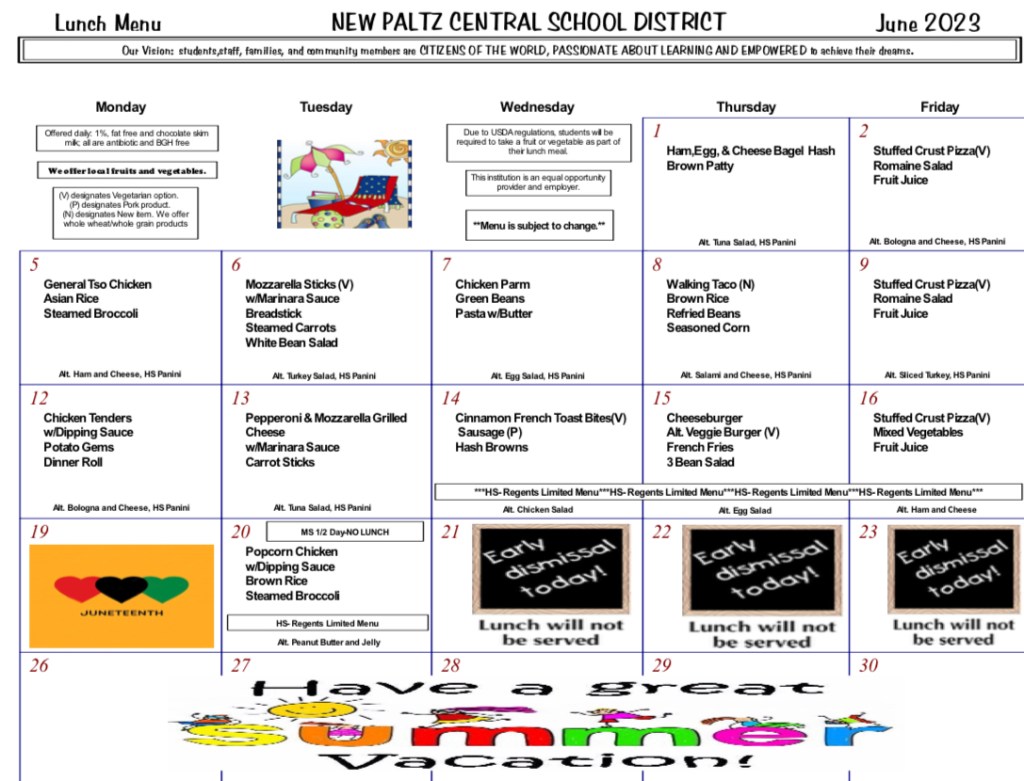
Now, with more understanding of the true significance that school provided meals have, let’s take a closer look at our own district. On New Paltz’s May lunch menu, there were a total of 18 different lunches, some only being different with their title, like “grilled cheese” vs. “mozzarella grilled cheese.”
“Better school lunches begin with dishes that kids already love. We try to upgrade kid classics with simple strategies like baking instead of frying (we are not allowed to fry due to trans fats) and Improve their favorites with healthier ingredients.” Director of Food Services, Sheila Moran explains while referring to these different options throughout the month. “We try to ensure kids are offered plenty of variety.”
Although the thought is that having 18 different lunches will provide “plenty of variety,” many of these meals are just variations of one another that students with dietary restrictions are not able to eat. 13 of the 18 have meat as the main part of the meal. The other 5 options consist of meals like mozzarella sticks, grilled cheese, or mac and cheese. In other words, if the meal is not made up primarily of meat, it is made up of cheese.
Thankfully, the hot lunch line is not the only option at New Paltz High School. So what can you find if you go in the other lunch line? Ham and cheese on a bagel, a burger, a buffalo chicken wrap, and the oh so popular chicken sandwich. Then what is left for a vegetarian or vegan? A grilled cheese or the salad bar with either overdressed or completely dry lettuce.
Dwan sees the same issue within her own school explaining the option for vegans is an Uncrustable, and for those that are gluten free the hummus and carrots are the go-to.
If New York State prides itself on always providing its students with “healthy and nutritious meals,” then there should be a focus on having plant-based meals as another well-developed option for lunch. Holding this standard is no stretch as to what schools should be capable of. Physicians Committee for Responsible Medicine reports that New York City schools now serve “Plant-based meals exclusively to all 1 million students on Monday as a part of their Meatless Mondays campaign.” This idea has been implemented in the NYC schools as a means of promoting health because the meals are free of cholesterol, low in saturated fats, and packed with fiber. New York City schools are not the only ones making the shift when it comes to the classic school lunch. Of the 2 million meals Santa Barbara Unified School District in California serves each year, approximately 50% are vegan. This school district is also home to many school gardens that provide for a space for students to “learn about the benefits of fresh fruits and vegetables.”
Although at the moment, the culinary garden and the courtyard at New Paltz High School are not in tip-top shape, these too can serve as amazing places for students to learn and to grow plants or herbs. Understanding that schools across the country are adapting to meet the dietary needs of their students as well as putting a focus on nutrition and healthy options makes it apparent that New Paltz Schools and other schools surrounding us are making changes too.
Hunger impairs cognitive abilities and concentration. So, to no surprise, the analyzed data found in research done by the Healthy Schools Campaign concludes that improved nutrition in schools leads to “increased focus and attention, improved test scores, and better classroom behavior.” With about $16.3 billion coming to these federally funded programs, it is a crucial conversation to hold about where public dollars are spent when dealing with children’s nutrition and health. When students are provided with the proper resources and diverse food options, there are exponential benefits for their physical health as well as their mental health. Creating nationwide waves hoping for change in school lunches is a difficult task, but what is feasible is creating a ripple within New Paltz Schools. Utilizing New Paltz’s resources, like the different gardens, as well as reevaluating school lunches to see if the menu still fits the student demographic, will lead to positive changes within the community. It is time to demand more options for students who are gluten-free, vegetarian, dairy-free, or vegan. I’m sorry to say it, but Tostitos chips and a scoop of hummus are not cutting it for a “nutritious and delicious” lunch.
Just food for thought.
If you are looking to read more into what Lily Dwan has to say on the topic, go check out Journalism & The Media 2023. You can find many other articles ranging from entertainment, personal profiles, and the news!
 The Maroon