 Posted by
 By Jiho Son, Staff Writer
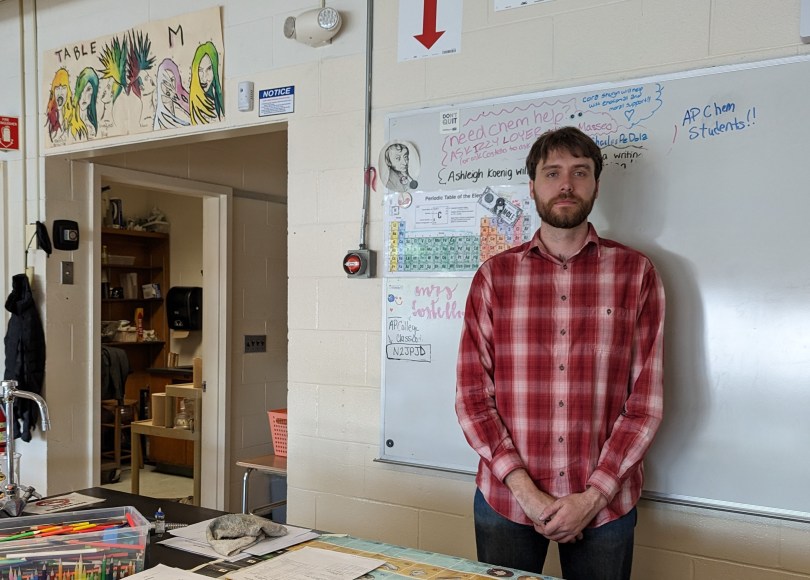
Following the recent retirement of Ms. Costello after 34 years teaching students at New Paltz High School, a vacant spot needed to be filled for the final quarter of the year. Mr. Eckert is an alumnus, and so he has sat as a student in the very same room he now teaches chemistry. In his teaching debut, he has found support and inspiration from parents who also happen to be science teachers, one of which, his father, is currently working in the room next door.
Prior to the pandemic, Mr. Eckert worked as a diamond grader in the city for nearly two years. During COVID, he came back upstate, but struggled to find a new career path. Two things that had always been a part of life as the son of science teachers was… teaching and science. With a father who taught earth science, bio, and chemistry at Valley Central for over 30 years, and a mother currently working at Monroe Woodbury as a physics and forensics teacher, it was almost inevitable Mr. Eckert would end up doing something in the science field, if not education. Now he does both.

“I guess the more your parents do something, the more it’s kind of in your mind because you’re exposed to it every day; they come home and talk about it.” Eckert commented.
Upon seeing an opening at New Paltz, as well as having been in contact with Ms. Costello a while back, Mr. Eckert figured it would be a good opportunity to come in and finish the last few months of Costello’s course to see if teaching is something he would want to pursue. A 10 week experience, it gives him the chance to do more than a normal sub would do, not just come in for one class and then leave.
“You have to plan a lesson, give out work, collect it, grade, put in grades and then figure out what I’m doing the next day, hopefully before I get there… half the time I came up with it that morning.” Eckert confesses.
Being exposed to science as a child influenced the direction of his career paths and interests. Doing experiments and other science related activities at home fascinated Mr. Eckert as a kid. From raising tadpoles, to catching spiders, to collecting bugs and rocks and quartz crystals and other mineral samples, science was always a constant aspect of his childhood. This taught him how fun science could be. He says this experience reminded him of a quote from Adam Savage, co-host of Mythbusters and Unchained Reaction, as well as a science youtuber, where he says, “The difference between screwing around and science is writing it down.”
Eckert adds, “You write it down so then other people can reproduce that experiment and understand the principle that is happening.”
“You write it down so then other people can reproduce that experiment and understand the principle that is happening.”
Mr. Eckert
One specific memory that sticks out is a liquid nitrogen demonstration shown to him by his mom. She would take a rubber handball, which is obviously elastic and bouncy, and stick it in the liquid nitrogen and let it cool down. After you take it out it shatters like glass, and then will become warm and pliable again, showing how when you cool something down it loses its elastic properties. You can also make toast with liquid nitrogen by dunking a piece of bread until it is completely frozen. You wave it in the air to make sure you are not eating any liquid nitrogen, and then you can break off and eat little pieces of cold toast.
Having an experienced parent teaching science in the same building has proven to be very helpful; at times too helpful.
“It’s helpful because there’s someone I know I can go to if I need help.” Eckert says.
His father is always willing to share information and materials, so willing that sometimes it could be said he is too helpful, and there always seems to be something else he wants to give. “It’s like actually you gave me enough for the lesson and I got it and I just need to work with what you gave me.” Although sometimes it can be a little much, Mr. Eckert says he is not worried about it because he knows his dad is excited that his son is here teaching, and his overwhelming assistance is coming from a good place.
Other than having a family with a science background, the logical nature and future prospects of the subject have always appealed to Mr. Eckert.
“I think very logically, and science is very logic based so I feel at home in it; there’s always a solution and there’s a way to find it as long as you follow the steps.” Eckert explains.
Though he understands the important cultural aspects of fields like English, science seems to have more logical, concrete benefits. “Another thing to think about with science is that, in terms of our country, in terms of our future, in terms of individual futures and freedoms, it’s very much a way forward into the future.” He explains that science is extremely relevant in terms of economics, technology, and health advancements. He cites a friend working on neurodegenerative diseases, a field that, with a breakthrough, could help a lot of people. For example: “People like my granddad. He had Alzheimer’s and he passed away in his 60s. So it’s like, it could help a lot of people and it could do a lot of good.”
“Another thing to think about with science is that, in terms of our country, in terms of our future, in terms of individual futures and freedoms, it’s very much a way forward into the future.”
Mr. Eckert
Mr. Eckert recalls a feeling of being inspired in one of his classes as a student, “And I was like, you know, it would be nice to be able to inspire students the same way that I feel right now, and I don’t know if I’m managing that but I hope I can.”
He finds it very unfortunate how the U.S. has started to fall further behind in science, and hopes to help inspire kids to want to go into science and “hopefully help bring us back to the forefront.” Though a noble cause, he questions how realistic this expectation is nationwide, especially with “how underfunded education tends to be.”
Unfortunately, the vacant spot left by Ms. Costello will be absorbed next year, and Mr. Eckert will not be returning to the chemistry classroom. However, he does plan to pursue a masters in education, or find another pathway to certification. “I have the science background so I’m able to present the material and understand it, but I need more of a teaching background so that I can better meet student needs.” Sometime in the future, he plans to come back and work either at New Paltz or some other district nearby.
 The Maroon