
 Posted by
 By Oscar Vandermer, Staff Writer
Science Research at New Paltz High School is more than just a class. It’s a lesson in perseverance, humility, and independence.
Science Research is a dual enrollment course through the University at Albany spanning the start of a student’s sophomore year to the end of their senior year. Through this course, students develop their own novel research question, create and conduct a unique methodology, and write a paper detailing their results. Starting the first year of Science Research can be daunting. Each student has very little idea of where they want to start, and three years of a mostly self regulated research project ahead of them. The first hurdle in this journey is deciding on a topic area to focus on, and ideas can come from all different places.

An idea might come from an interest in fixing an important issue like it did for NPHS graduate Sage Rochetti ‘23, (left). Her project “The effect of soil contamination and mitigation factors on carbon and nitrogen assimilation in arabidopsis thaliana” examined possible ways to mitigate climate change and carbon emissions through safe, accessible, and affordable biotechnology. “I felt like not enough people cared about the future of our planet, and I really do. I want to have an effect.”
An idea could also come from something as straightforward as making an observation and asking one simple question: why? For NPHS graduate Mike Lynn ‘23, (right), this was the case. “I was out cliff jumping with some friends over the summer and noticed that I started to do more flips and tricks when I saw a group of girls walk by.” His curiosity and desire to learn more about what happened ultimately led him to the research area of predictive risk taking.

Through the process of completing a project, students almost always pick something up they can transfer into the real world. “I learned a lot of real life communication skills, especially dealing with rejection,” Sage says, “learning how to roll with the punches is a skill.”
Like Sage, Mike understands how the skills transfer to activities outside of school. “It’s a great experience,” says Mike. “It can get kind of boring sometimes but can really help with willpower and just being able to get things done. And you definitely learn how to write a great email!”
The experience of having to reach out to professionals and seasoned academics in a specific field also can have great benefits. “Luckily for me, my mentor worked at SUNY New Paltz,” said Mike, “It meant that I could leave school and go to a meeting with him to hone and refine my rough ideas. It felt almost like being a college student.”
Sage, who found her mentor through a college course she took over the summer, agreed saying “making connections with a professor is very beneficial, more students should try to find similar opportunities to that.”
This essential process of finding a PhD mentor to help with an extended research project for the next 2 ½ years is different for everyone. Some could send 30 emails attempting to convince someone to help them, and others could send two. But once they find someone, it really launches their project off the ground and helps them to understand the research process in a deeper way.
“It was a humbling experience” says Sage, “I always figured research was a hard job since it’s so novel, but while actually doing it, you realize there is a lot more logistically and communication-wise that goes into it. I still think I want to pursue it further though!” Students feel the opportunity to participate and try out a career that you might want to pursue in the future is a valuable experience, and Science Research provides that experience in a unique way if you’ve ever considered research as a career before.
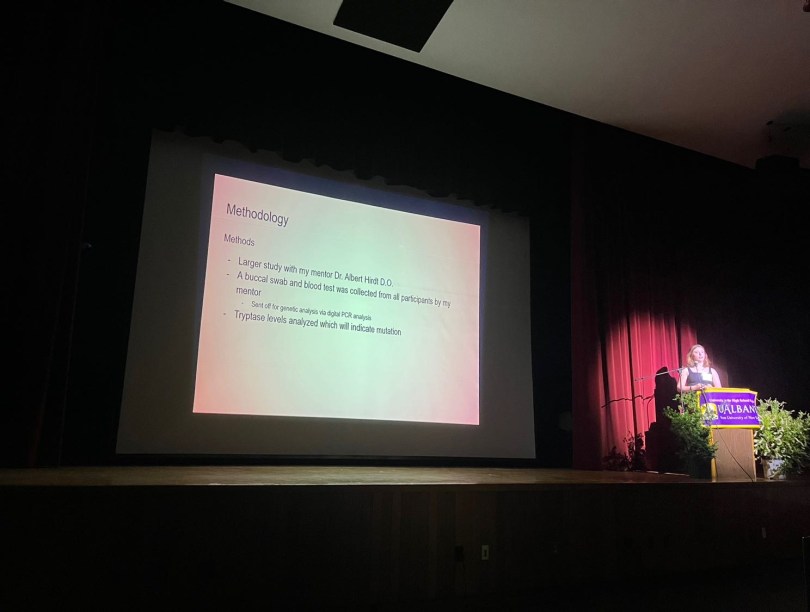
Through the Science Research journey, students will also have several unique opportunities to present their work in front of an audience. Besides getting the satisfaction of finally showing the constant work and effort they’ve been putting in for years to other people, they get to learn how to put any performance anxiety they might have to the side and focus on the fun aspect of sharing their work. According to both Mike and Sage, presenting was some of the most fun they had in the program (once the anticipatory nerves subsided of course!)
“It’s great for fleshing out college applications, and after completing the class,” Mike says, “I felt a great sense of accomplishment.” Sage agreed with Mike’s words, but added, “you get an opportunity to pursue an educational avenue that is more like what you would see in college. Getting real world experiences like that is something more students should seek out.”
This course has led many students to pursue or even major in a branch of science during their undergraduate education. For example, Sage is now studying biochemistry at Fordham University and Mike is at the University of Washington, St. Louis, studying Mechanical Engineering. So if you’re a New Paltz High School freshman, maybe try applying, or head over to the symposium at the end of each year. You never know what you could find.
 The Maroon