
 Posted by
 By Lucca Falcone, Writer
All across classrooms of the United States today, students frequently utilize digital technology to aid their learning. Whether it be a cellphone, Chromebook, or SMART board, these technologies are all used in different ways to enhance education and make it more efficient and convenient.
But as time goes on, people agree that the effects of more technology in learning must be known, and what the positives and negatives are. Students want to know how they are being molded by these new influences. These topics range from mental health to motor skills and efficiency.

“It’s really convenient to have all this information at the tip of your fingers” says Zoe, a college student studying psychology. “Chromebooks and the internet are pretty much necessary for school now”, she continues.
As Zoe knows, convenience is a big positive from technology focused schooling. Chromebooks provide thousands of websites to learn from and use for work through just the click of a button, instead of taking the time to find a book to read to get that same information. For students, all the materials they need for school are now in one package. Everything from reading and writing to making posters and presentations can now be created online.
“Having all the resources and websites you need in one is really helpful,” says a New Paltz High School student, Naomi. With quick and easy to find resources, many students favor the ease and convenience that comes with Chromebooks. This was emphasized by some studies, arguing that students could easily use computers to find information and feel more confident in class.
At the same time, digital technology has been shown to make students more motivated and engaged in their work. Some studies showed that students felt more motivated when working on a digital project that allowed collaboration with each other, and teachers felt that technology had allowed each student a bigger opportunity to participate. This was supported by Teacher 1, an interviewee, who claimed that everybody could have a voice with more class oriented technologies like SMART boards.
Teacher 1, a teacher of pre-k students, says that “the SMART board is quite good at capturing the students’ interest”. She noted that, like the other teachers, digital technology and the SMART board helped students engage in interactive participation, and greatly assisted visual learners.
On the contrary, some think that these technologies could actually be having a negative effect on student engagement. Some stats say that the average teen student spends a whopping 7 hours per day on just their phones, far exceeding the 2 hour recommended limit. In an interview, Zoe claimed that because of this, students’ attention spans are harmed by such over reliance. She also asserted that the increase in technology over several areas of life, especially academic, has harmed people’s ability to socialize and maintain social connections with others. In addition, Teacher 1 claimed that today, with so many students frequently engaging in technology inside and outside the classroom, it’s become much harder to keep the attention of young students than it used to be.
“It’s a lot harder to hold these kids’ attention when we’re not using technology, like reading”, she noted. She argued that students increasingly needed some form of stimulation to be able to pay attention to handwriting and pen/paper assignments in class, which makes the teacher’s job harder and requires a lot more effort.
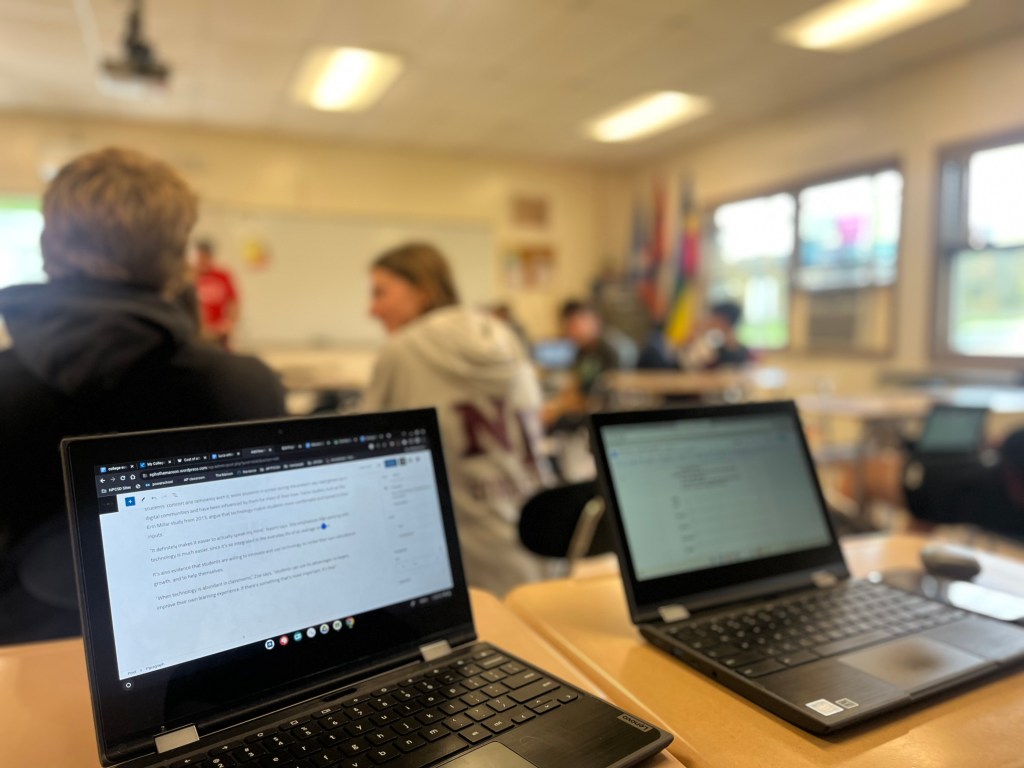
While teachers discuss this point, what can’t be disagreed upon is technology’s efficiency. Tech like chromebooks makes research and information gathering a much quicker and easier task, and typing long form essays takes less resources, like paper.
“I think that working with chromebooks is more efficient and neat, since all your resources are together,” says Naomi. Like said student, plenty in classrooms believe that chromebooks can be used to quicken the pace of learning and could be a time organizer.
Yet others think that tech can actually be a cause of distraction. Among many, there is a belief that students could be too fixated on such exciting technology, drawing attention away from other things. In one study, many teachers echoed the concern that constant interaction with Chromebooks and the internet would frequently draw students’ attention away from their work and toward whatever they felt like doing with their tech.
“Sometimes I’ll see students playing games with the tech they’re given, instead of focusing on what needs to be done,” said Teacher 1. Her comments show that a growing number of teachers are starting to recognize how this common aspect of school is affected by technology.
However, there are still more positive aspects. One of the final benefits of tech in the classroom is students’ comfort and familiarity with it. Most students in school during the present day have grown up in digital communities and have been influenced by them for most of their lives. Some studies, such as the Erin Millar study from 2013, argue that technology makes students more comfortable and honest in their inputs.
“It definitely makes it easier to actually speak my mind,” Naomi says. She emphasizes that working with technology is much easier, since it’s so integrated in the everyday life of an average student.
It’s also evidence that students are willing to innovate and use technology to center their own educational growth, and to help themselves.
“When technology is abundant in classrooms,” Zoe says, “students can use its advantages to largely improve their own learning experience. If there’s something that’s most important, it’s that.”
 The Maroon