 Posted by
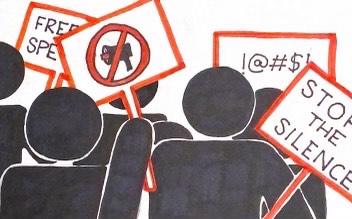
 In AP Language and Composition, students are asked to explore complex questions and synthesize their thinking. Here are just a few of the many thought-provoking responses students had when asked about the extent of the First Amendment.
Writing by Anna Goodman-Staff Writer, Nectarios Rodriguez-Writer, and Georgia Schultz-Editor-in-chief
Featured Image by Shelby DeJong, Staff Editor
Anna Goodman
“We, the people, in order to form a more perfect union, establish justice, ensure domestic tranquility, provide for the common defense, promote the general welfare, and secure the blessings of liberty for ourselves and our posterity, do ordain and establish this Constitution.” I was in first grade when I first read the Preamble, in a small, burgundy book my political scientist mother had given me. I turned six years old, just one month, three weeks, and six days before December 14th, 2012, and the shooting at Sandy Hook. I have grown up doing lockdown drills in four different schools, in every classroom I have ever been thrilled to learn European History in or bored to tears learning Algebra II in. On the first day of my senior year of high school, I was instructed by my first period teacher to throw a desk at a man with an AR-15 if the police failed to stop him from breaching the door. She had reason to spend fifteen minutes giving this talk: in 2021, the CDC reported, gun violence was the main cause of death for those 17 and under.
In the wake of yet more violence, both in our country and abroad, one has to wonder what on earth has possessed people. And the answer, resoundingly, is other people. As the country mourned the deaths of twenty children and six brave adults, I returned to just another day of first grade cutting construction paper while my parents were frozen watching the news. Far-right conspiracy theorist Alex Jones added one more to his tally:
“Folks, we got to get private investigators up to Sandy Hook right now. Because I’m telling you this—this stinks to highest heaven.”
For the last ten years, Jones has made millions from his InfoWars website and podcast and made the lives of dozens of grieving parents absolute hell, leading to their harassment on the street and uncountable amounts of death threats for their supposed “faking” of the school shooting. He lost the defamation case against them in court but has refused to pay, and the cost of his words cannot be overstated. But Jones didn’t send the death threats. Jones didn’t walk up to the parents face-to-face and scream at them. Jones didn’t go to their houses and force them to move. So how can he be held guilty for words, for just an honest opinion, when the foundation of the United States of America, the first of the ten amendments to the of the Bill of Rights in the Constitution, is freedom of speech?
The amendment’s exact words are “Congress should make no law abridging the freedom of speech or of the press”. If this sounds incredibly vague, that’s the entire point. It was one of the central tenets that Madison insisted on in the Bill Of Rights, and he, like many of the Democratic Republicans, was fearful of their new country becoming anything like Britain, which had responded to their protests with repression. Just a couple years away from the quarter-millennium anniversary of the Declaration of Independence, we still live under the rules created by a group of white slave owners attempting to carve a jagged middle path of freedom for themselves and, at the same time, the complete subjugation of those that they saw as less than human. Yes, they were revolutionary, but they were also far more similar to their British counterparts than we, or they, would like to believe. The Amendment is so vague that it can be twisted in whatever way someone (who perhaps has read it in full and is speaking of it to those who have not) wants it to be. This way, Jefferson, Madison, and others could use it to support their rhetoric against Britain and yet kill the people they deemed their own property for escaping a barbaric system and educating people about it. After learning this, perhaps the phrase “Land of the free and home of the brave” sounds more like a cruel joke than anything to be saluting a flag for.
Most people can look at Alex Jones and, despite his cries of “free speech”, see some level of culpability for the things that the parents of the Sandy Hook victims have endured, but the larger question of “what does this mean” remains unanswered.
“Using free speech as a cop-out is just as intellectually dishonest [as using the right to bear arms to protest gun control],” the New York Times opinion piece “Free Speech Is Killing Us” states. The article continues, “the brutality that germinates on the internet can leap into the world of flesh and blood,” just as it did with Alex Jones and Sandy Hook.
But this isn’t only an issue with screaming conspiracy theorists and whoever accidentally stumbles across their bizarre beliefs. So many politicians around the world–Narendra Modi in India, Rodrigo Duterte in the Philippines, and of course Donald Trump in America–have weaponized public hate through platforms like Twitter to convince a public terrified of change that the only way to prevent it is to put their trust in a fear-mongering strongman who will fight the bad guys for them. The only way to fight a bad guy with a handgun is to fight a good guy with a round of bullets, right?
Trump himself is facing several indictments for the lies he’s spread, none with more far-reaching consequences than the January 6th insurrection, which the indictment itself stated was “built on the widespread mistrust the defendant was creating through pervasive and destabilizing lies about election fraud.” Trump’s lawyers, meanwhile, have responded to these allegations, claiming that Trump genuinely believed that he won the election and was doing the right thing. Since it’s nearly impossible for laws to truly know what was inside someone’s mind at the time of a crime, the question is, does it really matter whether he thought that he won the election or not when the result–a case of treason that the entire country watched happen–is the same? If someone commits a murder accidentally or on purpose, even if the charges and consequences for the perpetrator may be different, someone are still dead. With Trump’s reinstatement to Twitter in the lead-up to next year’s presidential election, there is no telling the amount of disinformation, scaremongering, and conspiracy theories that will be spread through it, and no telling if those tactics will gain a treasonist a second term as President of the United States of America. Coincidentally or not, Alex Jones is credited with helping Trump get elected.
Giving people like Trump and Jones, who perpetuate the very worst misogynistic, xenophobic rhetoric, a platform to express their beliefs can only lead to carnage for the people their “perspectives” are firmly against. Free speech and hate speech are not remotely the same thing; all “perspectives” are protected, but it stops being a matter of “perspective” when people take it and use it to justify their crimes. Trump shouldn’t be allowed to be on social media after using it to incite people to violence and a coup d’etat against his own country when he outright lost an election that he insisted was rigged against him. People are entitled to believe whatever they wish, but once they push their beliefs onto others, once “free speech” is used to justify Holocaust denial and white nationalism, they must come under scrutiny. Simply put, free speech is not freedom from the consequences of actions but merely freedom to say things in the first place. It is not “silencing opinion” to take away access to massive platforms from conspiracy theorists, but instead a matter of national safety and a necessity to have a functioning country that is not being run by a president’s three am anti-Semetic rants on a social media app viewed by billions of people. There is, of course, no perfect fix for this, but banning the leaders of these conspiracies from public platforms is at least a start and must be done before anything else.
“The government may be working to prevent [white supremacist] violent acts, but it’s devoted less time and fewer resources to the toxic ideology that knits them together,” says the Atlantic’s article, “How Many Attacks Will It Take Until The White Supremacist Threat Is Taken Seriously?”
At six years, one month, three weeks, and six days old, my peers and I were exactly the same age as the students at Sandy Hook Elementary School. It isn’t lost on me that had I been born somewhere else, had my life gone a different route, it could’ve been me or someone else I care about. At seventeen years, zero months, two weeks, and one day old, it isn’t lost on me that one day it still could. The disinformation and blatant lies spread by these conspiracy theorists hurt all of us, and so all of us must do something to stop them.
Nectarios Rodriguez
There are not, in fact, limits to speech, but there should be consequences. Speech is the president of hate but also hope; therefore, to mitigate the hate, we should ostracize and correct the amount of hateful rhetoric perpetuated. In a digital age, the expression of taboo opinions in niche communities has been magnified tenfold by the creation of social media. We (the people) should hold these websites and companies accountable as moguls of modern speech; they should penalize their user base for perpetuating hateful rhetoric openly. Individually, we should hold our peers and friends to the same standard to better their morale in a progressive world.
FIrst exploring the real-world implications of ‘too much’ free speech—the case of Kevin Mathhewson. Kyle Rittenhouse, who was incited by Kevin Mathewson’s ‘kenosha guard’ post, killed two civilians as well as leaving one with serious injuries. Matthewson’s post led to approximately four thousand Facebook replies and the assembling of a rudimentary militia to combat the riots in downtown Kenosha. The assembly of the militia, the subsequent shooting of three civilians—these actions were only perpetuated because of Matthewson’s call to arms. Matthewson addresses his audience of supposed do-gooders to “defend” against “evil thugs”. His statement displays clear vigilantism—a means to an end no matter what the cost. Thugs, not humans. The apprehender of a thug is a hero. This obvious tone of dehumanization towards the protesters shows Matthewson could not have cared if those three people lived or died. Matthewson should be held accountable on not just Rittenhouse’s part but on the entire militia as the unofficial ‘general’. He made the call to arms, he suggested violent retaliation, and he demeaned the protestors’ very humanity for thousands of people to interpret. What furthers his involvement is his previous attempt at inciting rage when protesters were rallying in response to the murder of George Floyd. A little more than 60 people responded. Mark my words: Mathhewson knows what he’s doing, subconsciously or consciously—that is, to incite rage. The response to a call like Matthewson’s on a small scale is a menial protest. The sad reality and extreme truth are outright combat, military-grade weapons, and unneeded death. This idiotic desire to play vigilante is absolutely unacceptable. This is reality, and Matthewson is not altruistic. Though he might disagree, he is the problem.
We are now analyzing the implications of “too much” speech on an influencer scale, platforming individuals and uplifting their delusions. Popular personality Keemstar, known for his series ‘DramaAlert’, has continued to perpetuate hate and delusion without opposition from YouTube. Throughout April of 2019, beloved YouTuber Etika had been tweeting a vast amount of homophobic and ethnic slurs as well as displaying erratic behavior on his streams. A concerned fan notified the police about Etika’s behavior, and the police detained him outside of his apartment. Etika live streamed the event on Instagram for about 19,000 viewers. Etika was taken into custody and held at a Brooklyn hospital. His erratic and impulsive behavior clearly demonstrated that he was not in the right state of mind. Despite this, Keemstar would interview Etika shortly after he was released. During the interview, Etika talked about life being a videogame and, subsequently, death having no meaning. Keemstar promptly responded, “Why not jump off a cliff then?” Etika would commit suicide on June 24th, 2019, with his body found in the East River. Though not directly involved with the incident, Keemstar validated Etika’s erratic and manic thoughts about life and death. His explicit involvement is undeniable. Even Etika’s suicide, jumping off the Manahattan bridge, parallels Keemstar’s comment to “jump off a cliff.” If anything, Keemstar corroborating these desires makes him directly liable for Etika’s death. He incited a person who was clearly unwell to end it all, and they did. Although Keemstar will masquerade his involvement by claiming his words were merely a joke or a hypothetical situation, Etika’s mental state, Keemstar platforming him during an episode of mania, and finally validating his thoughts clearly demonstrate that Keemstar understands the depth of his words and how they affect others. He has to play innocent. Keemstar’s actions represent a greater problem in the influencer space. These influencers with cult followings have a magnified range of speech that extends across their platforms. There is a problem when their influence is not apparent to them. It’s a level of insanity that causes the influencer to believe they are invincible and absolved of the consequences their words bring to others. Their fanbase will validate and excuse their actions, regardless of the actual problem. Finally, when they begin to be held liable by parties that aren’t their fans, they can play innocent. Because guidelines on platforms like YouTube do not abide by laws like in a court, there’s only a jury of viewers to decide what is right and wrong. Thus, cancel culture is born as a direct result of the bombastic free speech influencers perpetuate. Keemstar should not just be canceled but rather completely deplatformed, demonetized, and ostracized from any platform that would promote his name. Keemstar has continued to be monetized on his platform without consequence, despite his involvement with Etika’s death. Keemstar, if anything, profited off the publicity that Etika’s death garnered. His involvement, the publicity, and the profit he gained—Keemstar is a monster. He should be held liable in court for his involvement with Etika’s death and fined for any profit he gained during the ordeal. The access to fame for the general public has permitted those who don’t understand the range of their words to voice their delusions on a gigantic scale.
The social implications of free speech continue to perpetuate large-scale systems such as homophobia. When a person feels that First Amendment free speech is applicable to their own social views, they begin to apply this philosophy to justify any hate they spew. Even before I became gay, I was an effeminate boy. I had a higher voice and a feminine way of speaking. I was subject to ridicule from not just my peers but also my own family. Free speech philosophy oftentimes implicitly absolves the malice behind statements because the individual feels they are telling the unequivocal and objective truth. What constitutes free speech is often wrong in a social context. Only in a political and oppressive climate where the antithesis of free speech coexists with daily life is that philosophy real and applicable. Because American life lies in the comfort of knowing the antithesis does not exist in the form of any authority or an oppressive government, the social and political climate has shifted toward that comfort of freedom. Therefore, this archaic definition does not fit the current climate. Socially, these people should be held accountable by direct punishment from their authority figures or social reprimands to make amends for the damage they’ve caused. “Children soon learn that an insult is often as effective as a punch,” Navarro writes in the psychology of hatred. To understand the depth of hurting another, a child should not just apologize for their mistake but also treat the wound they themselves opened. To clean it, to patch it, and then to apologize. It is the same for an insult—respect is not as simple as accountability. Accountability teaches us shame, not growth. The truth is, the reason we believe in excessive free speech is why systems like homophobia still coexist with our daily lives. Institutions, such as public schools, hold every offender to small-scale slaps on the wrist punishments if they happen to be caught. They do not teach the child to be better. We do not teach what is wrong and how it is wrong; we just lay a bandage over the wound-free speech leaves by saying to respect others—to treat them equally. The problem is that we are not equal in society. Those who fall to the top of the hierarchy will weaponize their free speech against those at the bottom who use their speech to fight back with the power they barely have.
A new modern free speech is needed that accounts for media tycoons’ to combat the aging obsolete free speech that condones offenders to live without reprimand, consequence, and closure to those they’ve torn down.
Georgia Schultz
The United States of America has always been a city upon a hill in the eyes of the world. Promising freedom and liberty to all under its rule, many Americans pride their country on their privilege to speak their mind and express ideas without fear of repercussion, an entitlement many around the world cannot enjoy.
However, as hate crimes rise and fatalities occur less and less sporadically, this constitutional right is again and again called into question, highlighting the damage and violence this “freedom” has led to.
The people’s right to expression is defined in the First Amendment of our Constitution and has been a cornerstone of American excellence for over 200 years. The right to spread information through means of speech, or in the new age of today, online, allows a space for new ideas to grow, to be challenged, and to spread. Putting forth opinions, making mistakes, and questioning societal standards without resistance from the government strengthens the power of the words, making them more likely to incite change when necessary.
But when do words stop becoming words? When does exercising freedom of speech lead to discrimination, hate, and violence? If given the platform, is it possible to restrict people like white supremacists, misogynists, or conspiracists from spreading harmful and false information?
The answer lies in another promised and unalienable right to all Americans; the right to the pursuit of happiness. This does not mean just the act of chasing, but rather finding and experiencing this happiness. Each man, woman, and child is owed a fair and equal chance to obtain a satisfactory life without the risks of bigotry, hatred, or violence in the way.
Specifically, in the past two decades, the internet has been a hotspot for lies, racism, anti-Semitism and more. It has provided an avenue for extremists to reach impressionable people in ways never before possible and target specific people, groups, or communities.
In 2012, white supremacist Wade Michael Page was active in online forums related to the “racial holy war” and “white power”, before venturing to a Sikh temple in Wisconsin and murdering six people. In the appalling aftermath of the incident, message boards trafficked by white supremacists urged the community to follow in Page’s footsteps and “stop talking and start doing.”
Similarly, in 2022, 18-year-old Payton S. Gendron drove more than 200 miles to a Tops grocery store in a predominantly black neighborhood, where he shot and killed ten people and wounded three more. Gendron live streamed his horrific actions, and around the same time, a manifesto in his name arose, arguing that white people were in constant danger of being replaced by people of color.
These vile demonstrations of hate towards marginalized groups of people are not born from nowhere. Long before any incident occurs, there is a platform out there where those ideals of murder, racism and lies are validated. People like Page and Gendron are accepted for their beliefs, and are safely free to explore harmful ideologies such as the idea that the color of their skin makes them more worthy of life than others . Not only do their actions cause death and destruction, but they also incite further terror in innocent lives.
“We should not kid ourselves that hate will stay online,” deems Adam Neufeld, VP for innovation and strategy in the Anti-Defamation League. “Even if a small percentage of those folks active online go on to commit a hate crime, it’s something well beyond what we’ve seen for America.”
In today’s world, words no longer mean just words. These forums and livestreams are the opening of the floodgates, creating a “safe” space for bigots to “reason” about conspiracies and violence. It is indisputable that these platforms pave the way for real-world danger, as demonstrated by Page and Gendron’s horrific actions. In 2022, the Southern Poverty Law Center tracked 1,225 hate and anti-government groups across the United States, localizing online communities like the Proud Boys and the KKK. Comparing the statistics to the locations of most committed hate crimes, the results are not so shocking. Areas with a greater online influence of harmful ideologies had a greater tendency to result in lost lives, riots, or violence.
The constitution is a maze full of contradictions. Hate crime laws are constitutional so long as they punish violence or vandalism but not speech. On the other hand, threats of harm are illegal, as is inciting immediate violence, such as urging a mob to overtake the capitol building. Clearly, the line is blurry and hard to judge. But should there be a line at all?
After reading the names of those murdered by hateful online groups moving into the open, yes, there should be a line. Speech is free until it prohibits others from exercising their own pursuit of happiness. How can one maintain a fair chance at happiness and safety in life while being constantly marked as a target for violence, racism, and hate? Freedom only lasts until it impedes another, specifically when it is targeted with intention.
The world has always looked up to the United States; it has been a place of opportunity, freedom, and a chance to live your own American dream. But there is no place for “speech without repercussion” in this country. Not when people die, families are torn apart, and towns are destroyed. As demonstrated time and time again, violence somewhere threatens peace everywhere.
 The Maroon