 Posted by
 By Nectarios Rodriguez, Writer
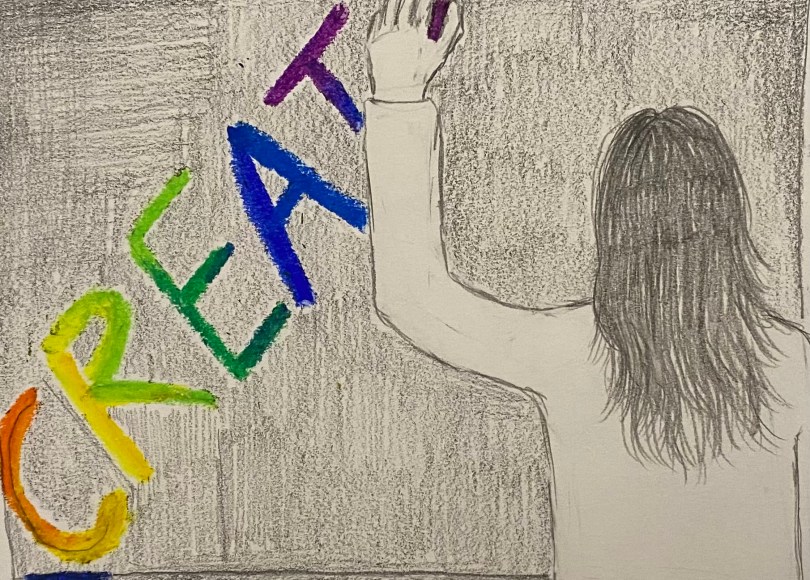
Graphic by Shelby de Jong, Staff Writer
It’s no question that the public’s “creativity quotient” has steadily declined since 1990. Creativity is the keystone to childhood, integral in fostering a future of intelligence, and out of the box thinking. In adulthood it is the currency that drives business, and incites change.
The creative mind can easily be defined and compared to the mind of a child who is unconcerned by what reality is. As a third grader, my friend Claire and I created our own line of smartphones and technology from scrap paper. Our greatest invention (in my opinion) was the “earphone” , a phone you could directly hang on your ear to take calls. We designed it keeping accessibility in mind. The design was clunky, but the idea was there. Shortly after, I thought of how my wired earbuds constantly got tangled. I wondered what wireless earbuds would be like. I crumpled two pieces of paper into small spheres, stuck them in my ear, and pretended that I was calling a very important business man. My point is, the absurdity of these inventions drove the creative process. The creative process is driven by that very absurdity. Almost like an algorithm we generate countless ideas before settling on one. From there, the inventor can work backwards, using knowledge and skill to bring that invention to reality, and then to others. Explicitly defining and teaching this creative in a classroom environment will almost certainly support the declining creativity quotient.
School (as we students/graduates know it) is an institution designed for compliance to make capable citizens. But as America and its market evolves so does its definition of capable. With this evolution, we begin accommodating new definitions for what is a capable person. Companies such as Google, YouTube, Meta, and Tesla don’t require human capital as they once did. With A.I. rising, formulaic jobs replace human labor which mitigates cost. These companies demand something that can’t be digitized– creativity. Schools manufacturer capable students and adults to an old standard of compliance, formulaic thinking, and work ethic. Companies now demand nuanced thought, an ethic that prioritizes work as an extension of family, and finally creativity. However, some still argue for the traditional skills school teach. That rhetoric is detrimental, these values are quite literally archaic and will often harm the student once in the real world. If each employer has the common denominator of wanting creativity, education as a whole should stand with that in the form of creativity classes. More often than not, interviewers will discard an applicant with a high GPA because they lack creative thought and collaborative skills with their peers. The toxicity that comes with grading manufacturers pompous arrogant children who are unwilling to be compliant in a collaborative environment. Ranks, numbers, and grades often prioritize a person with linear thoughts while demeaning a creative thinker. I don’t mean to suggest the abolition of grades– just an accommodation for already free thinking students by means of a creativity class. School as an institution is tacitly demoralizing creative children to become pushovers and leaving them to die in a world that demands creativity.
Creativity classes can come in mandated forms such as the arts. They should be open enough for even formulaic thinkers. Creative writing, band, choir, painting, ceramics, photography and 3D design can all be substitutes for a creativity class. Ideally this would be philosophical lectures that teach students to question the world objectively. The presentation of a question can lead to the discovery of a problem, the student can apply this philosophy to find their own solution. This is often how many jobs operate. Find a problem, find a solution of your own creation. In coding, programmers write lines of script and test their code working backwards to find problems in their own code. They have to identify problems in the code, switch and delete lines in order to achieve their vision. This mode of thought creates visionaries who see the dichotomy between their ideal and reality. Critics of this idea might go as far to call this delusion as they see fit. To say “free thinkers” will take their ideals to such extremes only to be crushed by the perpetual reality of American society. For example, some idealists want to fight the monolith of racism that is ingrained into American society, but give up as they realize the sheer volume of it all. I would condemn them as nihilists who refuse to incite change because of their own weakness and inactivity. I think idealism can create disappointment, but only depending on the individual’s mindset. One person might see that their desired reality is so far and they feel helpless to circumstances subsequently giving up. The other person will recognize reality as well, but accept it. They accept that radical change is gradual, not instant. This person might begin to fight racism on an individual level, educating family and friends before appealing to legislation with their ideals. This combats the existentialism that comes with facing gigantic systems.
 The Maroon