
 Posted by
 By Anna Goodman, Staff Writer
Freedom. What a word. It means so many different things to so many different people. When I went on a long-awaited trip to Northern Ireland last summer in order to track down my distant family, it changed my perception of the word forever. To the eyes of many, Northern Ireland is free. But, if Northern Ireland is free, why is there a sign in its Bogside district stating “You are now entering Free Derry?”

After the 1919 Irish War of Independence, Ireland was divided into Northern Ireland and the Republic. This followed hundreds of years of British imperialism and settler colonialism, such that a Protestant British minority lived among the Irish Catholic majority; laws favored the former and punished the latter. The Catholics were extremely under-represented in government due to gerrymandering, they were discriminated against in housing and jobs, and they could be imprisoned without even being charged. My branch of the family had left about thirty years before, during the famine, when the British refused to help and millions starved to death.
In the late 1960’s, new Republican organizations formed in opposition to these laws and practices and to Loyalist paramilitary groups. Some were nonviolent such as the Northern Ireland Civil Rights Association, but others such as the infamous Irish Republican Army, or IRA, fought the oppression with violence, especially bombings.

Tensions exploded yet again on the 30th of January, 1972, when the British army fired on a peaceful civil rights protest. Memorialized by the U2 song of the same name which begs, “How long, how long must we sing this song?”, “Bloody Sunday” ended with thirteen unarmed people shot dead–many in the back–with seven of them the same age as I am writing this article. Right where I stood.
The Troubles got more international attention around ten years later in 1981 when IRA member Bobby Sands was imprisoned for his role in a planned bombing and led nine fellow IRA members on hunger strike in protest of the conditions they were subjected to. Elected a member of Parliament while in prison, he died just a month later, aged 27, of starvation, followed by the rest of the strikers. He’s remembered as a hero and a martyr on the Irish Republican side, through songs like Christy Moore’s “The People’s Own MP”, and art like one of the many beautiful murals painted in the Bogside. Right where I stood.

Black Lives Matter, Palestine, healthcare workers, & LGBTQ+.
The Troubles (officially) ended at 1998’s “Good Friday ” agreement, when the people of Northern Ireland voted for demilitarization. In the thirty years since the Battle of The Bogside, almost 50,000 people were injured, and over 3500 people died, mostly civilians. Over 500 were under 20. And over 200 were from Derry.
After the 1969 “Battle Of The Bogside”, ‘You Are Now Entering Free Derry’ was painted on a house in the Bogside, a Catholic area of Derry just in sight of the 30 foot stone walls that keep the Catholics out and the Protestants in. “Then just an individual’s act of defiance, the slogan, and the wall, have now become an internationally recognised symbol of resistance,” the Ulster Museum states. The sign has since been painted over many times in support of gay rights, healthcare workers, Black Lives Matter, and many others. People from South Africa, Ukraine, South Korea, and displaced Native tribes from our own country have come to the sign in order to find a sense of community. I saw many of them standing there.

When I arrived, on a rainy Friday afternoon in July, what was on the “You Are Now Entering Free Derry” sign said, “Ireland and Palestine: one struggle”, as two hands, one with an Irish flag and the other with a Palestinian flag held a Molotov Cocktail that was almost the size of me. At the deaths of the hunger strikers in 1981, Palestinian prisoners smuggled out a letter stating, “We salute the heroic struggle of Bobby Sands and his comrades, They gave their lives for freedom.” Many prisoners there have gone on hunger strike too: one, in 2022, for 141 days, although thankfully, he lived. Now, in the aftermath of the declared war between Israel and Hamas, Ireland has gone against Britain again and voted to not suspend vital aid to Palestinian civilians, and the most current piece of art on the sign is an enormous Palestinian flag painted during a protest of the war just a few weeks ago.
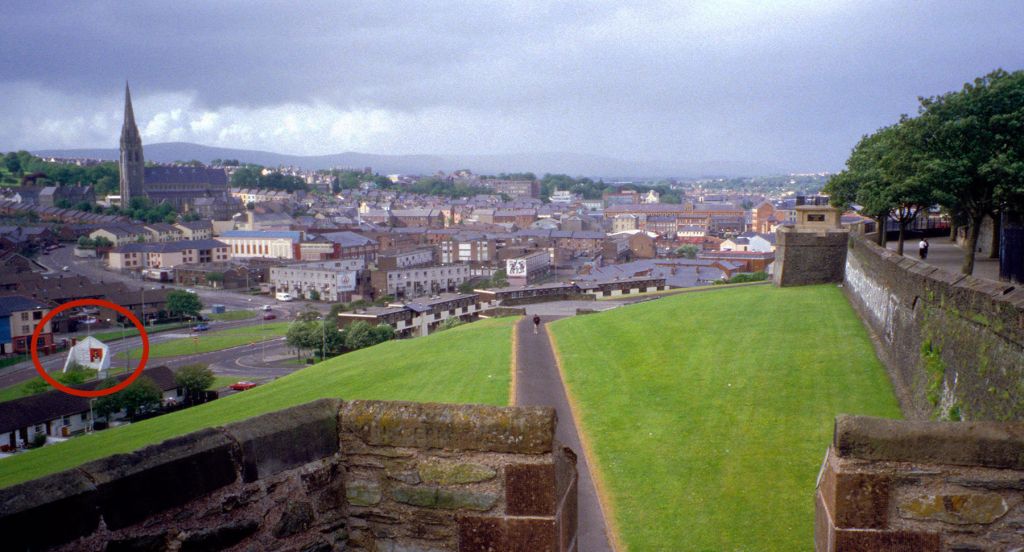
sign circled
But here we reach an important point. These “conflicts” are not the equally wrong squabbling of two equally placed countries. They are “conflicts” in the same way that the Russo-Ukrainian war is: they aren’t. And yes, there is and was violence on both sides, and none of it is justified and all of it is horrific and devastating for the innocent families on each side who have nothing to do with it. (See: “Zombie” by the Cranberries and it’s utterly gut-wrenching line of “But you see, it’s not me, it’s not my family.”)
But as the Wolfe Tones sing in their famous protest song about hunger striker Joe McDonnell, “And you dare to call me a terrorist while you look down your gun? When I think of all the deeds that you have done. You have plundered many nations, divided many lands. You had terrorised their peoples, you ruled with an iron hand. And you brought this reign of terror to my land.”

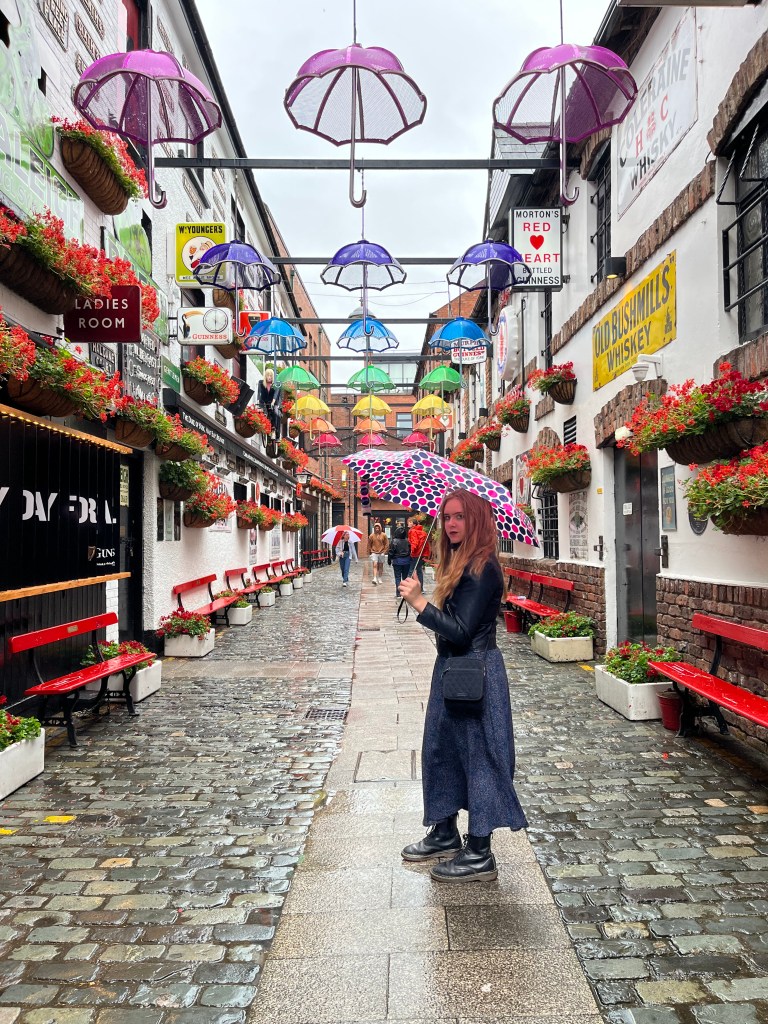
When I first landed in Northern Ireland, just on the eve of their famous 10-day-long Pride celebration and just on the heels of the July 12th “Orangemen” marches commemorating three hundred and thirty three years of British Protestant control over Ireland, my mother reminded me of two things: not to wear anything orange, or it could be seen as declaring allegiance to the Protestants; and not to state the names of the family we were looking for (as, although we don’t practice ourselves, McCallen is a Catholic last name). My mother and I shopped in tiny thrift stores in alleys, cooed at sheep crossing the road, and ate parmesan scones in a cottage cafe inside the walls of Derry, and it was bizarre, hearing accents that could’ve been carbon copies of my great-great-grandparents, yet constantly thinking, “What if she knew?”

As I walked on streets painted British red, white, and blue, covered in banners of the royal family and next to a border wall the height of my house, then stepped onto the next block, covered in rainbow flags and smiling shop owners, I have never felt so clearly two messages at the same time: “You’re not welcome here” and “You’re one of us, welcome!” On my desk there’s a framed photo of the “You Are Now Entering Free Derry” sign painted with a pride flag. I’m looking at it right now, and only just realizing that it doesn’t have an orange stripe.

my grandmother (age 65), 2014

I went on this trip to find out where my own (Catholic) family came from, led by a map that’s been gathering dust since Raiders Of The Lost Ark came out, a few post-it notes scribbled by my late grandmother, and many afternoons searching through illegible hundred-year-old church registers in Latin, and I ended up finding where I had come from instead, never expecting to find a story that not only went beyond me and them but went across centuries and touched the hearts of so many. As the Free Derry Museum states, “[Derry] tells the story of how a largely working class community rose up against the years of oppression it had endured. The struggle of Free Derry is part of a wider struggle in Ireland and internationally for freedom and equality for all.”
“Everyone, Republican or otherwise, has their own particular part to play,” Bobby Sands said in his posthumously published book. “No part is too great or too small, no one is too old or too young to do something. Our revenge,” he finished infamously, “will be the laughter of our children.”
When I re-traced the steps of them all, soldiers and civilians, passersby and protesters, it almost felt like some invisible hand took mine and showed me the part I had to play. To repeat, “This isn’t over”, to carry the strength that the words “You Are Now Entering Free Derry” has given me, to hope that one day all of the people oppressed under a foreign power will be able to proclaim that hard-won freedom for all the world to see, to wish that no one else will have to die before they can live. And some part of me hopes it sang to me too, in the words of a famous old Irish ballad, “Oro, Se do bheatha abhaile!” Or, “Oh, Welcome home!”
 The Maroon