“Playing music is not easy,” a truth that Gary Gibson of The Seattle Times and almost every instrumentalist knows. Music requires patience, innovation, and concentration, skills valued by school districts along with the twenty first century. But across the country, music programs are being cut, even here in New Paltz.
Ms. Foti and a few choir students practicing a concert song
In the elementary schools, music classes have been cut in half, with general music, chorus, and band meeting much less than they used to. Last year’s budget crisis has been a reason for this, as well as the implementation of New York State’s Next Generation Learning Standards. NGLS calls for more time spent on Mathematics and ELA in the classroom, and creates standards for students in grades preK-8.
Subsequently, music classes have been suffering with the need for school districts to comply with these programs. This loss of the arts, especially in youth education, can have serious – if not detrimental – impacts upon students. Music has many benefits for everyone, including strengthening literacy, creating a more holistic education, and bringing students closer to culture.
Music has many benefits for everyone, including strengthening literacy, creating a more holistic education, and bringing students closer to culture.
In seventh grade, I pulled apart Let Her Go by Passenger for an English project to identify the literary terms. The assignment ingrained in me what the terms meant, what they looked like in context, and how what had seemed like outdated words were connected to my life. Dee Hansen and Elaine Bernstorf, co-authors of “Linking music learning to reading instruction,” came to the same conclusion, their study identifying six main components of literacy music helps with. They found childrens’ books likeOne Fish, Two Fish, Red Fish, Blue Fish teach rhyme and rhythm, skills not only vital in learning and understanding music, but also writing structure. Their study of language found phonological awareness, phonemic awareness, sight identification, orthographic awareness, cueing systems awareness, and fluency are components of speech and literacy that are critical in knowing and understanding not only language, but music as well. The study on parallels of music and English education reflects my own experiences, and concludes that having these classes side by side can aid students in strengthening these skills for the rest of their life.
This practice of literary techniques using methods other than textbooks and readings can only be defined as holistic, a type of education more and more parents are seeking out because it “recognizes the importance of a child’s social, emotional, physical, and spiritual development.” Introducing the diversity music education can offer creates an engaging and innovative environment for young students, giving them an opportunity of expression and creativity to explore different instruments and theories. This keeps students interested and engaged in their education, practicing academic skills in a creative way that can benefit them throughout their whole lives. The Walton Academy gives the example of a student finally mastering a song. It gives them the confidence to continue playing because of the achievement, as well as the motivation to continue learning more and more challenging music. While this seems to satisfy a short-term need for students to be on top of their education, it also prepares students for life. They’ll be confident in interviews, persevere past a shortcoming, and motivated to meet deadlines. Incorporating music into the daily experience of a student can apply and build skills students may be lacking in a traditional classroom environment. Music education can provide reprise from mundane math and science and give students a chance to explore and apply skills they’ll need throughout their life.
And in that life, music will constantly surround them, manifesting itself in commercial jingles and car radios even if they don’t search it out. Culture, anywhere in the world, is communicated through music, and students who are given the opportunity to learn music can learn that culture. A large part of music education is devoted to exploring other cultures, and many band and choir directors choose songs in other languages or by foreign composers, all with the goal of teaching students about different cultures and representations of music. Many people describe music as a “universal language,” and its ability to transcend writing is unrivaled, uniting peoples and places with its ubiquitous presence. One can argue that the human experience is the culture they’re surrounded by. And while there are 195 countries and even more cultures, music is what surrounds and connects them all. As a choir student, I’ve sung in almost a dozen languages, from French to Swahili to Lithuanian, and all have brought me value and helped to understand the culture and history surrounding the songs. Music education can broaden students’ cultural horizons and teach about the various cultures throughout the world by teaching what unites all of them – music.
Many people describe music as a “universal language,” and its ability to transcend writing is unrivaled, uniting peoples and places with its ubiquitous presence.
Music surrounds us. It’s part of day to day life, whether it’s a song stuck on repeat or restaurant background sound. It seems odd that something so integral to global society can be overlooked so easily by the educational community. Music is one of the few subjects applicable to many facets of education; crossing cultural horizons, teaching language, and even changing the way we look at schooling.
Many extracurriculars are on the chopping block for numerous reasons, and music isn’t the only subject suffering. However, music adds diversity and perspective lacking in other core subjects. Celebrating diversity is also a goal for schools today. Increasing music education simultaneously teaches culture, language, and expression, and has the power to create change.
 Posted by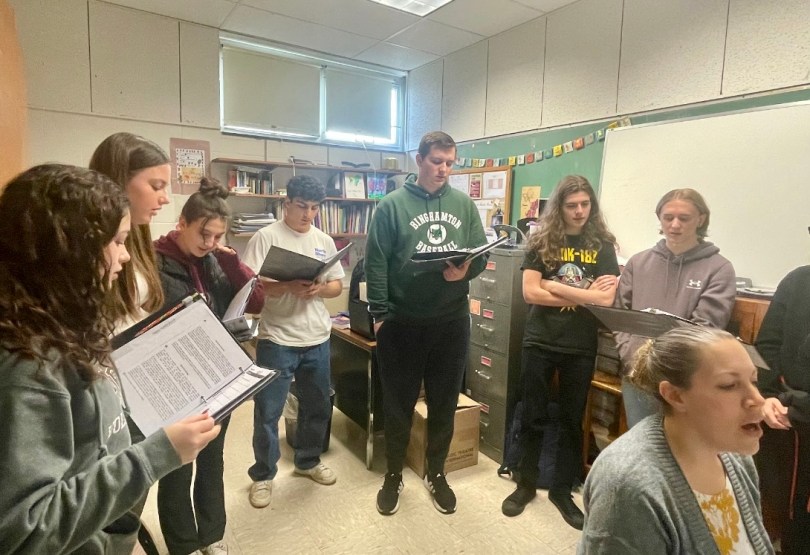
 The Maroon