 Posted by
 By Staff Writers, Lily Nocito, Clea Spring and Lucas Camiola
Around the world, the universal language is photography. You constantly see cell phones raised up to capture anything they can, just for the purpose of being able to look back at it later. But what about the past? Before 2007, people didn’t have a cell phone to snap a picture within seconds. Before the cell phone, there was the flip phone, then digital cameras, but before anything, there were film cameras. Film was much harder to use; people had to buy film, load it correctly, and then develop their photos using a darkroom. Did you know that New Paltz High School has its very own darkroom for this purpose specifically? Bet you didn’t. So many students have straight access to the past, and they don’t even know it.

“It’s good to know the history,” Mr. Martin, the school photography teacher says, “for almost 200 years, this hasn’t changed.”
In Martin’s class, every student learns about the history of photography. First, they start all the way at the beginning: the pinhole camera, which was created by a hole in a box. Then, throughout the first few weeks and many hands-on experiments, the students then learn about photography up until present time.
“Up until 1826, if you wanted a picture, you had to paint it or draw it…and then you’re literally painting with light,” Martin says.
There is a high percentage of students at New Paltz High School who enjoy photography and composing pictures. From just going to a sports game you will find countless students with digital cameras, trying to capture the perfect action shot. Mr. Martin created a very well rounded curriculum for his class, which many students have benefitted from.
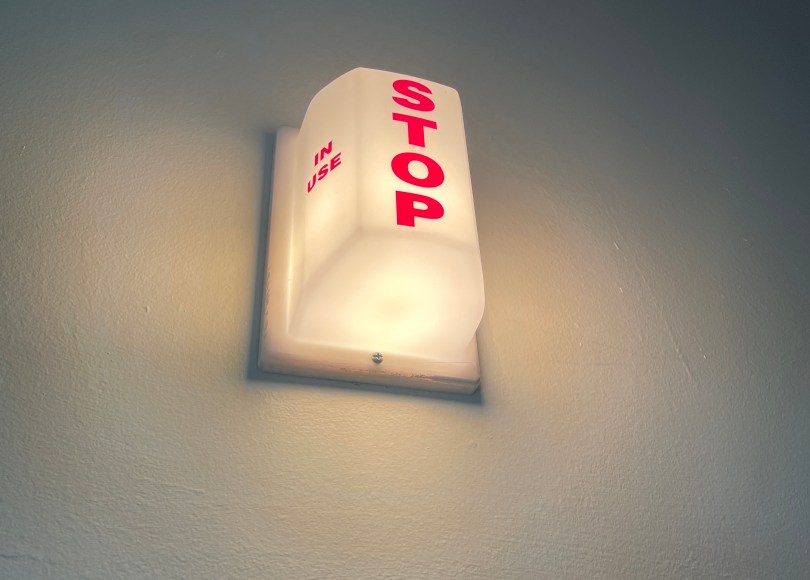
One hidden gem this class has to offer is the darkroom. This fully functioning blast to the past is open to any student within the photography program. Asking around the school, most students either didn’t know where the darkroom was, or that it even existed.
“Instead of seeing life through your eyes, now you see it through a lens… things that you wouldn’t have seen before taking the class.”
Kala Schultz, Junior Photography Student
“It was something I’ve never seen before,” photography student Kala Schultz says, “You kind of saw it from a different angle than what you were expecting.”
Right when you walk into the darkroom, you’re met with a short winding maze which is meant to block light out. Don’t hit your head! Because film paper is so chemically fragile, it can’t be met with any type of light before it reaches the fix, which is where red light comes in. In every corner of the room, there are small red lights which you turn on to be able to see. Only red and amber lights are able to meet film paper. Any other light is forbidden in the darkroom, however some students like to go on their phones, and that can ruin your film. Once, to try and play music, one student found an old radio and figured out how to play the right channels on it, further extending that idea that this darkroom is like a time machine to the past.
“It’s really cool to be able to see that actual process… and a little more appreciation for what we have now with the idea of what we used to have,” says AP Studio Art student Aivyn Hemminger.
The class itself is split into groups, and these groups switch out of the darkroom every other day. This allows all students to get a chance to work on their assignments in the darkroom equally, making contact sheets and final prints for their photos. When a group is working in the classroom, they research for upcoming assignments, develop their film reels, and eventually, mount their finished work.
“Instead of seeing life through your eyes, now you see it through a lens… things that you wouldn’t have seen before taking the class,” Schultz explains.

The students’ finished and mounted work will eventually make it to the art show, an opportunity for students to show off their completed photo work. The Art Show also shows drawing & painting work, computer graphics work, engineering designs, ceramics, and film & video assignments. For photography students, they learn to manage their time on their own to complete eight final prints to be shown in the art show, so time in the darkroom is critical. Students in other schools don’t have this amazing opportunity to experience photography in the form of film.
“I’ve gained independence now and how to problem solve,” Schultz says.
Students should definitely capitalize this opportunity to use the darkroom while they can, because they most likely won’t get this chance later in life to explore the unique chemistry of film photography. New Paltz High School is one of few schools in the county that have a darkroom to use, so why wouldn’t someone take a kick at the can at that amazing advantage? If anyone reading this wants to take photography, or learn about how to use film, talk to Mr Martin, and jumpstart your journey into the past.
 The Maroon