
 Posted by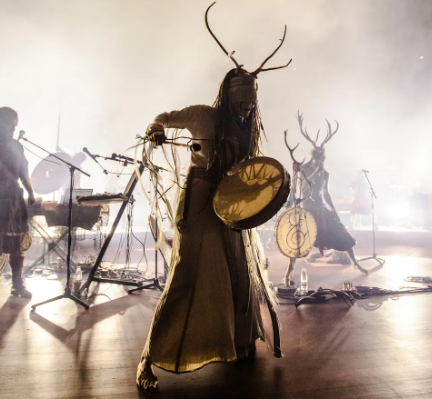
What did you do during the height of COVID? Did you bake bread? Did you nearly murder your sister (and would’ve if your mom hadn’t come home with groceries at precisely 2:27 pm on Wednesday the 19th?) Did you aggressively take up crocheting and then equally aggressively realize it wasn’t for you? I didn’t do any of those things. My father is the bread baker in my family, my sister lives a continent away, and I’ve already aggressively realized that my crocheting is utterly terrible. Instead, I walked outside and listened to Norwegian viking music.
You might be thinking, what? Why? Well, in an era where music can feel so overproduced, there is a comfort in Scandinavian folk being the opposite of that. In fact, it centers around nature, even down to the composition. Many songs by Wardruna (a Norwegian folk band that takes inspiration from Vikings) open with it: with heavy wind, crackling flames, flapping wings, cawing birds, howling wolves, rushing water, clinking rocks, and stomping hooves just a few of the sounds they’ve used. When you close your eyes and listen, a part of you might just believe you’re standing at the top of the fjords in 1023.

in “Kvitravn”
“If you choose to laugh at Wardruna,” pop culture magazine The Quietus warns, “don’t assume they aren’t in on the joke. In a cynical age, he gives us plenty of room to be affected by the magic he is conjuring.” You may think that this music, that magic itself, is a relic of a long forgotten era. But it isn’t. “The current climate emergency cannot be separated from the messages of Kvitravn [the latest album],” the article continues, “When Selvik [Wardruna’s lead singer] tunes into nature he traces how it is changing.”
And nature is changing. The averages recorded in the last ten years make them the warmest on record, with roughly two or three degrees per century predicted. While this may not seem like much for those who don’t live in extreme climates, those that do can see it in front of their very eyes. Norway’s glaciers are starting to retreat rapidly, and Sweden’s mean temperature increase has been faster than most of the world, meaning that summer mortality in Sweden could be raised by 5%.
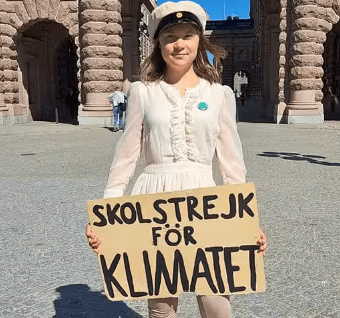
Perhaps this rapid changing is one of the reasons why it is much harder for those in Scandinavia to ignore the climate crisis–and why they won’t let us ignore it either. Greta Thunberg is perhaps the most recognizable face of climate change advocacy for our generation, since she began her protests at 15 out front of Swedish Parliament in fury at her world being taken away. “I don’t want you to be hopeful,” she said. “I want you to panic. I want you to feel the fear I feel everyday. I want you to act like you would in a crisis. I want you to act like your house is on fire because it is.”
But the evidence being right before their eyes is perhaps not the only reason that Scandinavia is leading the way when it comes to renewable energy. “Across the Nordic region,” writes Max Naylor in his article, “How The Nordics Are Standing Up To Climate Change”, “there is a tradition of looking after the environment. One striking manifestation of this is a lack of litter and relatively low levels of pollution…Icelanders and Norwegians in particular feel a deep sense of connection to the land.”
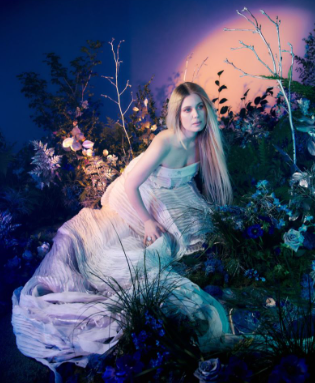
As Amelie Bruun, Danish singer of the black metal folk band Myrkur puts it, “I grew up in a place where you are allowed to believe in trolls and elves and the power of Thor’s hammer. I long for something pure and to be united with the nature I grew up around. I seek a connection to mankind and womanhood, nature and gods around me. This is why it saddens me when nature gets torn down to make room for empty and impure things.”
Bruun’s songs reflect this as well: one of her most popular, Ulvinde, says, “Langt ned i de dybe dale, der spejler sig i søen, Under flodens askegrene finder jeg min sjæl.” “This is where I want to live, this is where I want to die, Under the ash branches of the river I find my soul.” Just as the article before stated that Wardruna’s messages and climate change are deeply linked, so too is folk music around the world. Bruun agrees, saying that, “Folk tales help us be human, they bring us guidance…that’s why we still listen to this music…it’s why they were passed down from generation to generation…”
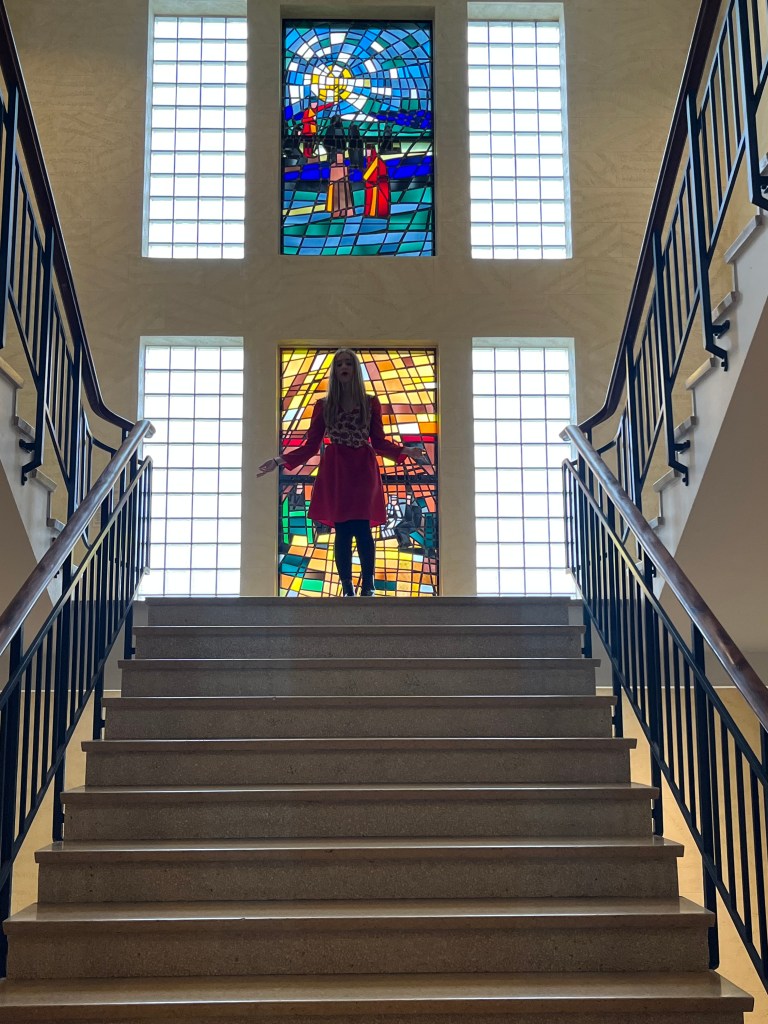
preserved centuries-old stained glass windows in the National Museum Of Iceland
Bruun herself has compiled an album of these tales, called Folkesange, or “folk songs” in Swedish (“Fager Som En Ros”), English (“House Carpenter”), Icelandic (“Tor I Helheim”), and her native Danish (“Gudernes Vilje”), and all tell a once-lost story, some of her own creation. “I wanted to create an authentic folk record, but not a dirty museum piece,” she told Apple Music about the album, which covers topics from miscarriage to Viking legends to the beauty of the seasons. “We wanted lots of space, like being in nature, where you have the space to breathe.”
Those who lived in America a thousand years ago as the Vikings roamed over Norway have had their culture forcibly erased and their connection to nature ridiculed as “savage.” But it is we who are wrong. We stand in our cities of glass and polish, and say that we are the “owners” of a land that we are in the process of destroying.
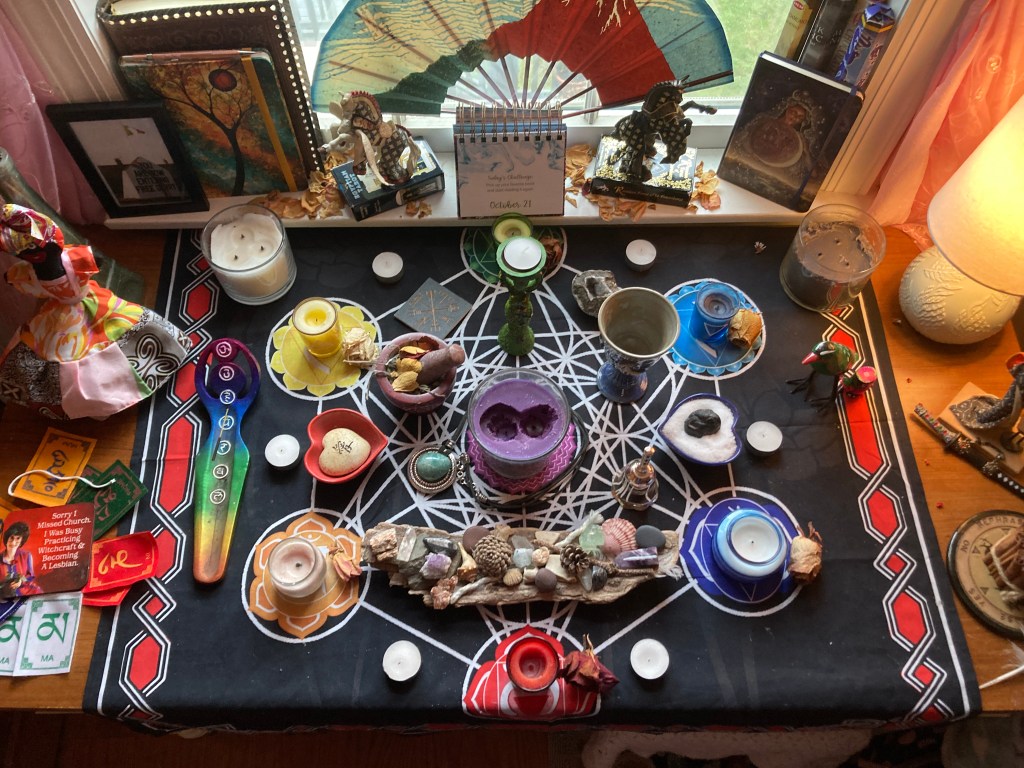
the sun, the moon, and
the ancestors.
As a practicing Wiccan myself who first found it suited me around the beginning of the pandemic, this message of nature’s connection to the soul and its stabilizing impact truly spoke to me, perhaps because Einar Selvik is himself a Pagan and greatly features the religion’s tenets in his work. It teaches of the necessary balance between fire, water, air, and earth, balance between the sun and moon, balance between the different stages of a human life cycle, and balance in general in different aspects of life.
Most importantly, it teaches compassion, especially that for all living things, no matter how insignificant or irritating; hence, the Wiccan Rule: “If it harm none, do what ye will.” Due to these beliefs, many Wiccans and Pagans are environmentalists themselves. When the vast majority of my life (and everyone else’s) shifted to being completely online, it was in nature that I could close my eyes and finally breathe.
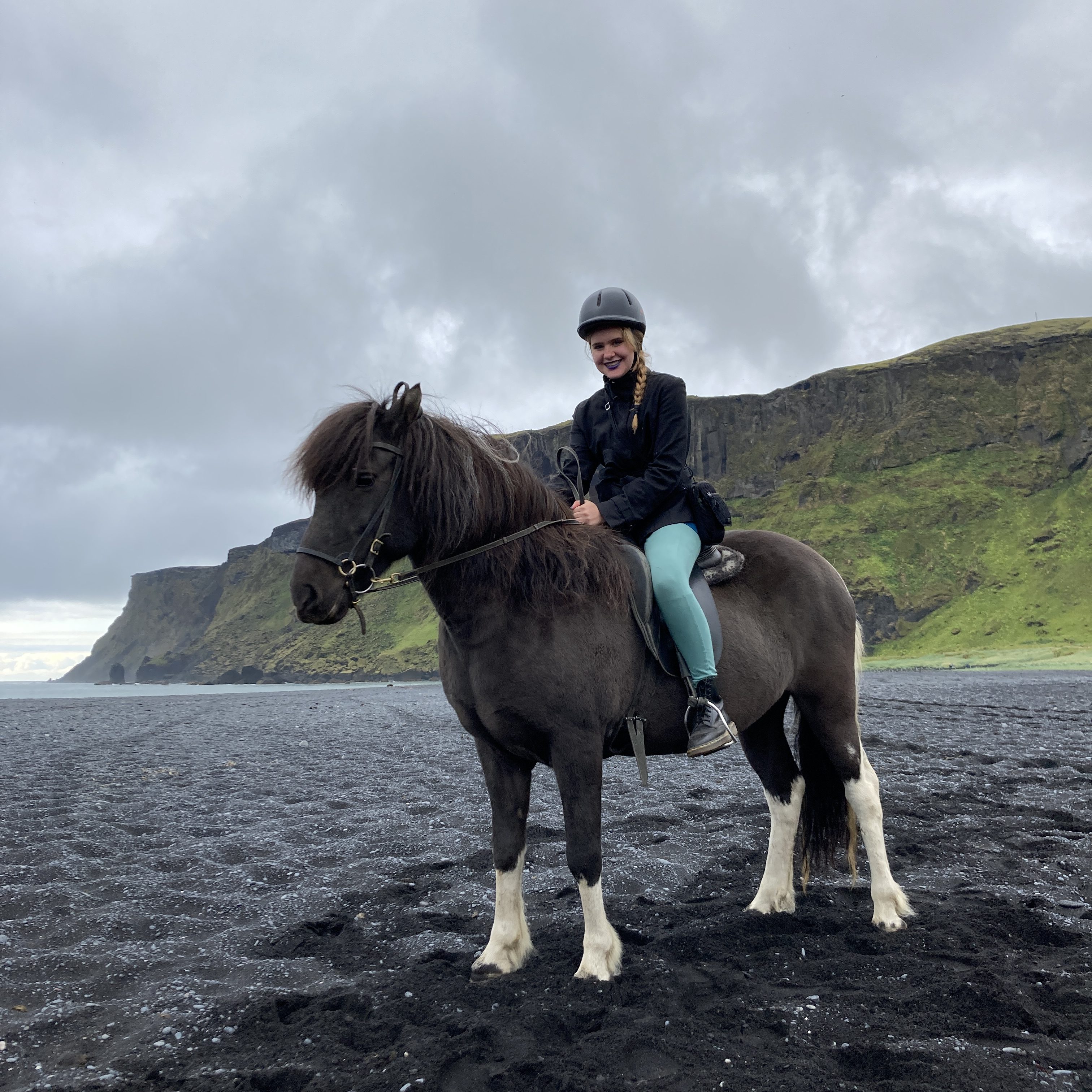
After most considered the pandemic over, I took a trip to Iceland with my parents to escape the heat of summer that is slowly becoming less and less escapable. Though we were there in August, I relished the cold of the so-called “Land Of Fire and Ice”, enjoying the feeling of a heavy coat on my shoulders and the thick wool pants once worn by my great-grandfather in the WWII Navy, and it’s this that I was wearing when I walked to Jökullsarlon, which translates to “glacier lagoon.” The lagoon hasn’t always been there, but years of global warming have turned what was once a total sheet of ice into a lake.
As we trekked down the beach on horseback, I asked my riding instructor–an Italian woman named Stella who, after a decade of living in Iceland, still shivered at the wind–what the villagers in the town of Vik will do as the volcano erupts more and more due to the climate change looming.
“We have home insurance,” she told me with a shrug.

Dismounting from the pony (a tiny Icelandic called Skota, so dark she nearly blended in with the sand), I ventured onto a place called “Diamond Beach”, where pieces of ice so stunning they can be mistaken for glass have washed up in the surf from the lagoon, and rest on a bed of ground-down ash that has become like sand. Unable to stop myself, I held a piece of it in my hands, and felt the water seep through my gloves. It felt a little like walking to the edge of the world, and it was then that I realized that even if I did, even if I journeyed to the Arctic Circle, I couldn’t really escape the heat.
Maybe I haven’t managed to convince you to give Wardruna or Myrkur a try. Maybe you still think that the idea of trekking dramatically in the woods while the loud vocalizations of people singing a language you do not know playing millennium old instruments whose names you cannot pronounce sounds a bit ridiculous. That’s what I thought when Wardruna first came up on my YouTube recommendeds.

unseasonably warm day in Iceland,
listening to “Lyfjaberg”
But then I listened to Lyfjaberg, standing on that black sand beach, holding a glacier in my hands. Lyfjaberg, or “healing mountain,” begins with the sound of crushing leaves and a slowly loudening chanting rising from the depths of the ocean and only gets better as the singing begins and the only instruments playing are ancient drums.
Suddenly, I felt like I was floating, and more specifically, floating my way into a place no one had ever dared venture. Its bridge ends with the line, “Eg manar deg inn i berget blå, der korkje sol ell måne skin deg på, eg maner til skogen der ingen bur, og til den sjø som ingen ror, djupt under jordfast stein til ingens mein” , or, “I urge you into the blue mountain where the sun or moon shines on you. I urge you to the forest where no one lives and to the sea where no one paddles, deep under solid rock where no one can harm you.”
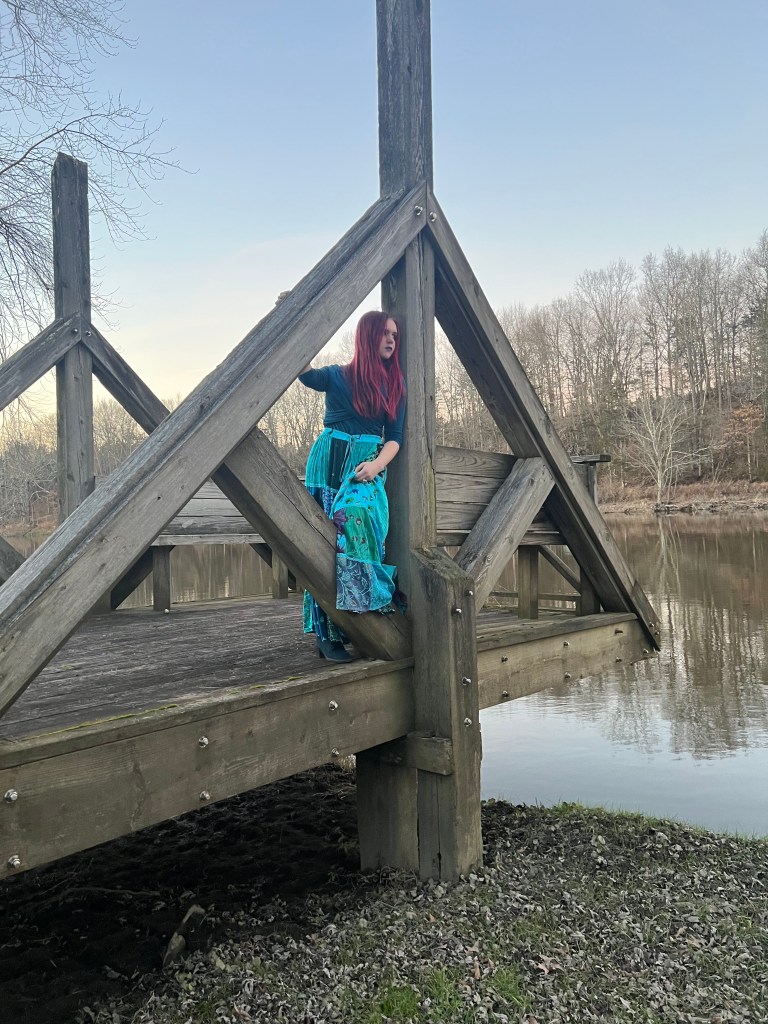
New Paltz, on a 55 degree day in December
And so, in keeping with the spirit of the Land of Fire and Ice, I urge you. I urge you to not let yourself be blind to climate change. I urge you to hear our planet, begging for a respite through raging wildfires, sixty degree Decembers, and screaming hurricanes. I urge you, even if you think you’re too young or too quiet or too…whatever to do anything, to do something. Walk barefoot through spring grass. Take ten minutes to sit in the sun and do nothing but drink lemonade. Run through the woods like a crazy person in a corset and a floor length patchwork skirt and feel the leaves snap beneath your boots. Most of all, I urge you to appreciate the intense beauty of the world that is currently at and under our feet. Because, at the very least, we owe it that much.
 The Maroon